Categories
Business Design Strategy

A Better You

Somewhere in the world, there exists a version of you who has all your skills… but does everything better. This person designs better, writes better, develops better, and strategizes better. How do you compete?

Develop Quality with Quantity

The brilliant Chris Brogan recently wrote about focus. In the post, Brogan argues the power of less – by stopping certain tasks (even some you may enjoy), opportunities arise. Doing less results in accomplishing more.

“At its root, focus is about less. There can’t be two #1 priorities…. It’s simple. It’s about less. (Want a hint about less? Check out The Power of Less.)”

Stop Flinching

Another way to defeat the better you: develop a higher pain threshold. Julien Smith, who released “The Flinch” for a free digital download this week, reminds us that pain and challenges must exist in order to develop your best work.

“Because you are a human being, you are programmed to settle in one way or another, and breaking that programming will hurt. Get used to it– it’s the only way to make something exceptional.”

You 2.0

Focus. Do less. Develop a tolerance and confidence in times of pain and challenge. These suggestions will help you crush you work no matter the obstacle.

The better you is shakin’ in his boots.
Categories
Measurement Strategy

Data-Driven Decisions

A recent client visit proved my Syracuse University talk to be a worthy one – sophisticated use of quantitative data allows for better marketing decisions.

Tools

Through the use of Google Analytics and Radian6, we made educated recommendations for how best to use the client’s web presence. What types of blog posts and announcements created the most traffic? What types of content attracted the most visitors? What messages resonated? And how did the conversation shift over time? These answers lead to well-informed recommendations – and more importantly, increased value for the client.

Measurement

The beauty of research and analysis in marketing: the data never stops. As strategists and marketers, we can “re-measure” digital data for the purposes of making even more educated recommendations. How is data helping you make decisions?

Categories
Business Design Speaking Strategy

Giving Back is Back!

Syracuse University
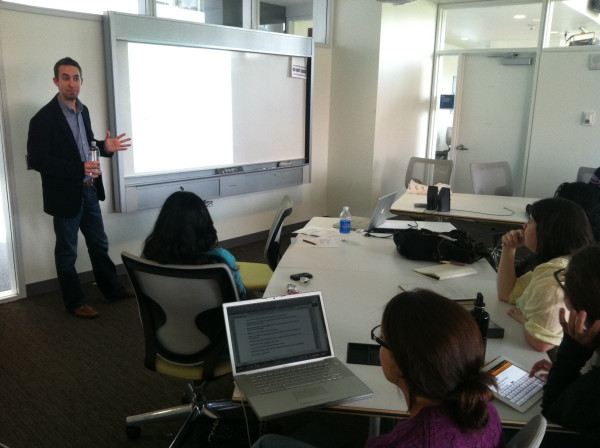
I spoke to three different classes about the role of research and analysis in marketing.

I had the pleasure of speaking at my alma mater, Syracuse University’s S.I. Newhouse School of Public Communications, earlier this week. It served as a proud moment for me – traveling back to Syracuse to share real-life experiences with current students. In short, I was able to “give back.”

Go-givers

However, none of this would have happened without the help of a giver: Steve Masiclat, my ex-professor-turned-colleague, who was kind enough to invite me into his class. More importantly, Steve did an amazing job at “making me look good.” By that, I mean he referenced specific parts of my speech as part of his teaching for the day.

I encourage you to give back to your school, community, or favorite charity. Much like my return to SU, I’m sure those acts will be incredibly rewarding.

So thanks to Steve for inviting me to the ‘Cuse. And thanks to HB for encouraging me to speak and for continually investing in my personal development. And thanks to all the grad students for listening – I hope my talk was valuable.

Categories
Design Strategy

An Event Apart Boston: One Week Later

Thanks to the kind folks at HB, I was able to attend last week’s An Event Apart in Boston, a conference for people who make web sites.After meeting hundreds of interesting people and listening to dozens of engaging speakers, here are my most important takeaways:

Lack of Control
You may not be in control of the user’s experience,” said Jeffrey Zeldman when kicking off the event. Throughout the week, we learned to design for the worst possible outcome. Even better, we should think responsively – sites must adjust to the user’s experience. Mark Boulton offered solutions with grids, while Ethan Marcotte suggested detailed media queries within CSS.

Content Comes First
Users should be interacting with content, not navigation tools or page structure. In fact, “content precedes design; design without content is decoration,” said Zeldman. We are redefining how we think about layout: content-out instead of canvas-in, said Boulton.

Experience and Users
Have a philosophy – especially one about how to treat people or make an impact, said Whitney Hess. Both your clients and your company should have a strong philosophy and/or design voice. In the mobile world, make things easier for users with customized input forms and remove extraneous page elements while elevating content, said Luke Wroblewski.

Plan for the Long Haul
How can we ensure that our brand lives on ten, twenty, or even fifty years from now? Jeremy Keith recommends text and open formats without restrictive licenses. Additionally, strategy, planning, and culture are all extremely important (Aarron Walter and Jeff Veen were particularly interesting to me from a strategy perspective). Take the time to develop patterns, prototypes, and design personas. Build a strong culture that allows for employees to work at their highest levels, especially in difficult times. And perhaps the most important thing I learned, courtesy of Typekit CEO Jeff Veen: “purpose is timeless.” Understand what problems you to solve, and the best place to do it.

Recap
In the end, it was a full two days of information digestion. I’m sure there’s plenty of great information I’ve missed… but what excited me the most were the talks that were more strategical and less technical. An Event Apart Boston gave me more fodder for thinking less like a designer and more like a creative problem solver. Big thanks to Jeffrey Zrldman and Eric Meyer for putting together a diverse cast of characters.

Categories
Design Strategy Uncategorized

What’s My Passion?

Minutes ago, I finished Gary Vaynerchuk‘s “Crush It!“, a simple, concise book that demonstrates ways to “cash in on your passion.” First off, it’s a great read and highly recommended (I’ll be starting his new book, “The Thank You Economy” in the coming days).

More importantly, the book lays out several steps to developing your personal online brand and eventually monetizing it. Perhaps the most critical of these steps is identifying your passion and committing to talking about it better than anyone else.

Over the years, I’ve put lots of hard work into several subjects (online), be it wiffleball or design. I also lived most of my life focusing on 3-5 passions, knowing the world is just too big to digest everything. Well, the time has come to potentially reduce that list to 1 passion for this site and my personal brand. The tough part: deciding on that passion. Here are the contenders:

  • Design and Branding (extremely broad and difficult to differentiate myself)
  • Living simply (admiring simple design and strategy, reducing the amount of “stuff” in one’s life)
  • Golf (the sport I will play the most for the rest of my life)
  • Technology (potentially in over my head)

There are other topics where I’m sure I could “crush it,” but this decision is an important one. I may even be forgetting something incredibly obvious – please make recommendations that may or may not appear in the above list.

In the words of LeBron James, what should I do?