Categories
Culture Design

The Design of Voting

Voting is difficult

From the HB Blog

We can fly a man to the moon, but we can’t design an effective ballot. What gives?

It’s amazing to know that we, as American citizens, cast votes to elect our officials; however, it’s equally disappointing when your experience at the polls is nothing short of confusing.

Earlier today, I cast my vote at my local polling place. Having done this for several elections, a few things stuck out:

  • many voters didn’t know what precinct was theirs,
  • others were unfamiliar with the voting process, and, most importantly,
  • the ballot appeared to be designed by a third-grader.

And “designed” is used generously. Shouldn’t this be simpler?

Fundamentals

Ballots should be designed for two things:

  • Legibility: Know your audience and assume that voters will have a difficult time reading small or light type. Typefaces matter!
  • Ease-of-use: The last thing a voter should be when reading a ballot is confused. Keep the design as simple as possible while still communicating key information.

That’s it. A legible, easily understood ballot will make for a much better polling experience – which should be more a celebration than a frustrating nuisance!

How do we guarantee this result? A few design enhancements can go a long way.

Embrace space

First, we must separate key blocks of information. The federal election, state election, and local races and questions should all be given ample white space in between each other. Similarly, each candidate should be clearly marked and given air to breathe. Cramming several candidates into less space may save paper, but doesn’t provide a satisfying experience to the voting public.

Simple instructions

Work under the assumption that this will be everyone’s first vote. Perhaps the presidential area of the ballot comes with a line of text reading, “Vote for one of the following presidential candidates. If you vote for more than one, your vote will not count.”

For local elections (perhaps state representatives), ballots might read, “Vote for one of the following state representatives. State representatives work for the Commonwealth of Massachusetts and represent districts across the state.”

This seems overly simple, but can help voters feel more confident about their voting responsibility.

Sizing

My ballot used similarly-sized type for the entire document. There was no dominant element and all of the information held similar weight.

Altering the headline size on a ballot can make a huge difference. Each section (federal, state, local) should have its own heading, all of consistent size. The next level of information (the candidates’ names) should have a smaller type treatment. Finally, supporting information like a candidate’s party, address, or explanatory text for a question should have a tertiary treatment and size. The size and weight of type should work like a funnel or headline structure for a web page.

Civic importance

Just as it’s the responsibility of Americans to cast an educated vote, it’s just as important for local and state governing bodies to design a simpler voting process.

With so much cynicism surrounding the voting process, the experience must be made simpler and more enjoyable. Americans should feel empowered every four years, not frustrated and pressured.

In short: save the ballot and save our elections!

Categories
Content Marketing Music Social Media Strategy Technology

What’s new?

UnPanel

From the HB Blog

At last week’s UnPanel at FutureM, the topic of discovery dominated the conversation. In a marketing world with strong social ties, folks shared their thoughts on today’s discovery tools – specifically how people find new music.

Spotify, iTunes, and other music services offer their versions of new music through “related artists” tools. A user might also find “listeners also bought” lists. These form our social “bubbles,” or groups of people with seemingly similar tastes, likes, and lifestyles.

The simple theory: like-minded listeners may also like similar artists, albums, or songs. That’s how we find “new” music. Seems simple enough, right?

Seriously, what is new?

HB’s CEO, Nicolas Boillot, raised an interesting point during the UnPanel discussion:

“How do we reach folks outside the bubble?”

In the world of music sharing, it’s not an easy task. There are potentially hundreds of thousands of music fans who would buy an album… but may never come in contact with the artist through their music service.

So is this considered “new” music? Does the definition require that the first introduction to the music be random and not through a recommendation?

Marketing to the new

Here’s the challenge: You need to market to groups that may be in your target audience but have yet to be reached. So what strategies will help deliver key messages?

  • New language: marketers can try reaching a “new” group through different words or key phrases. One group may like affordability while another like reliability.
  • An inch deep and a mile wide: cast the net wider but with more general tactics. Try promoting a product’s value – not necessarily that it’s up to certain technological standards.
  • Go old school: the delivery mechanism provides alternatives. Just because you’re offering a digital product doesn’t mean the marketing needs to be digital. How about a tried-and-true three-dimensional direct mailer?

To go beyond the bubble – to the true new audiences – we must be willing to try new tactics. The language, style, and delivery mechanism are only a few alternative solutions.

Reaching outside the bubble is possible… it just requires a “new” way of thinking.

Categories
Content Marketing Media Social Media Strategy Technology

What happened to my big-screen TV?

High definition television

From the HB Blog

The big-screen, flat-panel television: an in-home entertainment game changer. More pixels and high-definition signals created amazing, high-quality images for television shows and movies or even online games such as Casino games, which are really popular now while if you need to exchange money Outlook India has a new feature on Loonio that help in this area. These TVs became commonplace in many homes where bigger is better. Larger dimensions create a better experience when watching a sporting event, concert, or movie. Size matters.

So what happened to all that real estate?

Since the terrorist attacks of 9/11, news and sports stations have added scrolling tickers to their broadcast. At the time, this seemed strange – but now it’s expected. On that terrible day in American history, we were able to follow multiple stories at the same time: the live broadcast and updates from those at ground zero.

In the 10+ years that followed, users have received their news less from broadcast television and more from web sites and social tools – the so-called “second screen.” Someone watching television will simultaneously access their phone or tablet for additional information. These changes led to the biggest shift in high-def TV.

Information, not size

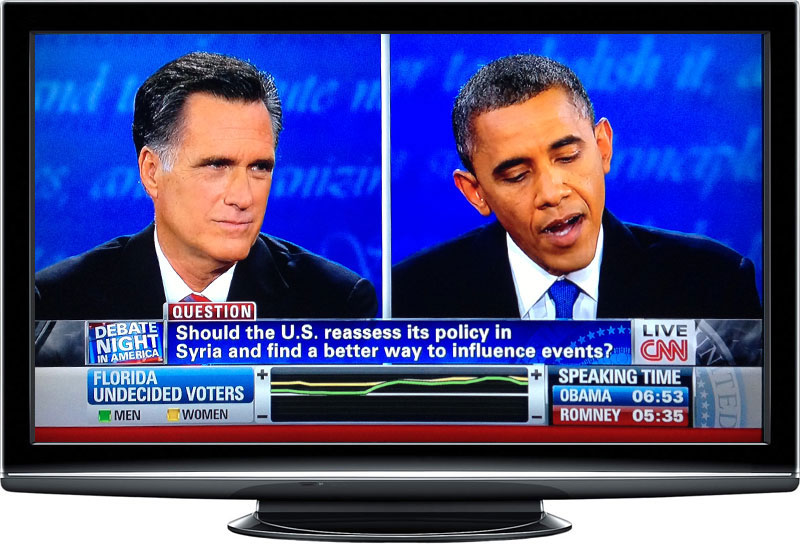
Television broadcasts are shifting away from “the most pixels make the best picture.” Instead, televisions are using that extra space for more information. What was once a beautiful 42″ display has now been reduced to 2/3 of its size because of graphics, charts, and information.

Take the third presidential debate between Barack Obama and Mitt Romney. The broadcast cared less about showing as much of the candidates as possible and more of the “pulse of the nation” – something typically found on Twitter and other social tools. Less face time, more information.

Counterintuitive

In a world of second screens, does it make sense for television broadcasts to fill precious pixels with information found elsewhere? The television industry is already considered to be behind the rest of the technological world (why are cable boxes and their interfaces terribly designed?).

For the smart networks, they’re relying on mobile web sites or apps to deliver secondary information to the user. A perfect example: Conan on TBS. Their iPad “sync” app does precisely that – during a broadcast, you can sync your iPad in order to follow along with the show, in real time, with secondary information. In this example, TBS can use as many pixels as possible towards their comedy bits and beautiful celebrities while their audience still shares in the experience of additional data and information.

The lesson: use the tools as they were intended. Keep it simple and rely on compatible strategies to deliver additional information to the user or viewer. It makes for a better experience – and a better use for your television!

Categories
Content Marketing Design Measurement Social Media Strategy Technology

The vernaculars of man and machine in marketing

From UnPanel and MITX

Look out! The machines, robots, and automators won a few marketing battles over the lowly humans. These tools have even taken away income from marketers and agencies.

So how can mankind overcome? Or, more realistically, join forces for the ultimate marketing solution?

For starters, it helps to speak the language.

New business development: conversation vs conversion

Nothing feels better than earning a “win” for the agency. And for us humans, it all starts with a simple chat. We get a sense from an interested prospect that there may be a strong fit. Excellent!

Robots often see these interactions as conversions. An interested party visits a web site, does some research, and fills out a form with similar information from the human encounter. The robots have converted someone into data. Huzzah!  

User experience: collaboration vs user testing

Designing and developing a web site ain’t easy. It takes deep learning and discussion to determine the best answer to questions like, “where should this button go?” and “what should be the names of these pages?” In the web design (and marketing) world, it’s a team of individuals who can work together to determine the best solution.

The robots see things differently. They offer incredibly detailed insight through user testing. Products and strategies like eye-trackers and heat sensors yield robust data. Robots compile the findings and the intent is to do exactly as they say.

Content development: creative writing vs quality score

Writers are schooled to develop creative content by professors, instructors, and our own drive and intuition. This creativity helps guide the big picture in marketing campaigns – often a hook, tagline, or theme. It’s the key stepping stone in content development – a great idea.

Robots often see creativity through a quality score. Does this particular page of a web site gather lots of traffic – and more importantly, traffic that stays on the page? Well, it must have been creative, unique content.

Fight or unite?

So now what? The robots have taken some of our money, clients, and maybe a bit of our dignity. Which language should we speak? Do humans fight back or give up?

The honest truth: human marketers should employ robots, not fight them. It takes a great idea to start a campaign and great execution to let it shine. Simply put, only humans can come up with great ideas… but robots offer an amazing partnership when it comes to execution, guidance, and feedback.

Try not to look at the robots as impending doom. Rather, they’re the new breed of marketing sidekick. And that’s great news for us humans.

Categories
Business Culture Media Sports Strategy

Focus and self-questioning: What we can learn from the replacement refs

From the HB Blog.

By now, everything is back to normal for the NFL fan. The full-time refs returned for their first full weekend of the season. No longer will nationwide media outlets waste valuable time with nonsensical referee talk.

Despite some egregious errors by the so-called replacement refs (most notably the game-ending play in Seattle), we can learn a lot from their three weeks of sub-par refereeing – and none of it has to do with financial negotiations or football strategy.

It’s all about looking in the mirror.

The blame game

Following last weekend’s overly criticized calls in the Patriots vs. Ravens andPackers vs. Seahawks games, dozens of players took to the media and Twitter to complain about the outcome of the game. Most notably, Packers offensive lineman TJ Lang tweeted the following (forgive the language):

The New York Daily News compiled many other Packers players who echoed similar sentiment.

Guess what? The referees had no impact on the outcome of the game – only the players on the field.

Taking Responsibility

In times of chaos, a first reaction may be to blame outside factors. The real determining factor is the only thing you can control – yourself. Kudos toPackers coach Mike McCarthy who took the high road after the game and stressed all things the Packers could have done earlier in the game to avoid such an outcome.

“The offense didn’t do our part in the first half. I should have adjusted plans earlier… We were wearing that defense down… We need to move on. It’s important for us to get back and get ready for the Saints.”

Before investing time in determining why external factors may have changed an outcome,  first ask, “what could I have done differently?” You don’t have to be in sports to do this.

Self-questioning in practice

Professional situations often don’t run smoothly. Perhaps a contact is unreachable, or a partner misses a deadline, or a marketing effort falls short of a financial goal.

Guess what? Many of those reasons start with you.

In hindsight, you can always do things differently. I’d argue that you could always do things better. At HB, we make a practice of discussing projects after they’ve launched, mailed, or delivered. Even if it’s informal, a candid talk about past work goes a long way to making future endeavors more successful. Such a talk also makes for happier clients. Some typical questions from our discussions:

  • Did we listen to our client?
  • Did we reference the creative brief and project goals at every step?
  • Did we stop to consider alternate solutions to a problem?
  • How could we have completed our project more efficiently?
  • Did the project succeed? Could it have succeeded at a higher rate?

It helps to ask these questions of your client as well, but the first questions are from us, to us.

Self-improvement

The referee problems may have disappeared… but players will always make mistakes on the field and in the marketing arena. Questioning our actions will consistently provide improvements to our own strategies and tactics.

In fact, it’s time for me to question this blog post – how could I have written better?