Categories
Business Design Strategy

The Look of Clean-Tech: Differentiating Through Design

From The Agency Post

Gone are the days when images of blue skies and green grass communicated everything that needed to be said. Clean-tech marketing has grown up and requires unique visual branding in order to attract attention in increasingly competitive markets. How can companies and technologies better represent themselves through design?

Invest in creativity

News flash! Logo and visual brand development isn’t cheap. But it’s important to look at the development as an investment, not a cost. The logo sets the tone for your business  – think of it as brand equity. The more you use it, the more equity your brand builds.

And don’t stop at a logo. A visual brand requires much more: deliberate use of typography, photography, colors and graphics. The fundamentals of a brand go a long way in clean-tech marketing as many companies haven’t invested the necessary time, money and energy into building their brand equity.

Embrace simplicity

A logo cannot possibly tell the entire story of your technology, business or brand. Think of all the time and effort you’ve invested just to launch the company! Much like your business, a brand is a living entity. It is enriched or undermined cumulatively over time – the product of a thousand small gestures.

Know that your logo or visual guidelines are only one part of your greater brand story. You want the mark to be simple, easily understood and flexible. The logo must work across the web, print materials and future applications (such as on a product, billboard or clothing). Think about all the places where your brand may show up – a little planning goes a long way towards avoiding nasty discoveries. For example, a multi-colored, complex logo may look great on a poster. But what happens when you place it over a colored background? Make sure the logo remains strong in its many variations (black, white, large, small, one-color, etc.) to avoid any pitfalls.

Aim high

Think of your brand as aspirational. The logo should communicate where the business aspires to be, not necessarily where it is now. When guiding a branding or design firm on its task, talk about your company as you envision it in five years. Are you a developer of wind energy struggling to raise funding and slogging through regulatory processes? Your instructions to your design team must focus on the future, when you might instead describe a sense of cleanliness, simplicity, stability and happiness.

Avoid Common Design Traps

We see many new companies falling into three common traps when using design to differentiate themselves:

Literally abstract:Your logo doesn’t have to communicate what you do. Rather, it can provide a symbolic, visual window into the business and its goals.

ExampleThe Geothermal Genius logo’s flexibility and forward-moving arrow don’t restrict its future to Geothermal solutions. That, combined with a professionally designed site, creates a solid visual brand.

No way cliché: A cloud can’t possibly distinguish you from another brand. Think beyond!

Example: Helix Wind takes an abstract design element to create the sense of moving energy for its logo.

In it to limitA wave alone can’t represent your hydroelectric company, especially when the business grows to offer additional energy solutions.

Example: Namasté Solar’s offerings aren’t limited by some representation of the sun. Instead, the logo’s modern, abstract design speaks volumes about its clean, peaceful brand and its future.

Following such recommendations requires care, focus and oftentimes a significant investment in a talented design team. Such investment can go a long way in the clean-tech world, which is relatively young and unsophisticated when it comes to marketing.

With any investment, the more equity you build at the beginning, the greater the returns in the end. Brand equity is no exception.


Categories
Business Design Strategy Technology

Polish or Perish: The Importance of Visual Identity in Clean Tech

This post was written by Nicolas Boillot with contributions from me. From The Agency Post

In the immediate future, the clean-technology landscape will experience a massive and sustained surge of investment during the convergence of:

  • Rising fossil fuel prices
  • Diminishing costs of clean and sustainable technologies
  • Increased clean tech efficiency ratios
  • Uncertain but sustained government incentives over several years
  • Available success metrics from early adopters in business and residential installations

This “harmonic convergence” will echo long into the future. Many believe the surge in clean tech will make the dot-com bubble appear as a mere speck along history’s trajectory. The clean-tech convergence portends a wave of startups; from Boston to Beijing, young engineers are putting to work the latest engineering wizardry to create new capabilities and reimagine existing technologies. Droves of investors are lining up behind them — global investments in clean tech surged 13 percent in 2011 and look to do equal or better in 2012, despite a hobbled global economic climate.

Technology doesn’t win by itself

After 13 years of serving engineering-driven companies at HB, we now understand that many companies with extraordinary technology often ignore their own brand. Brilliant engineers and scientists creating tomorrow’s winning technologies continue to believe that, “If I build it, they will come.”

But they won’t. After working with hundreds of technology companies and seeing some succeed and some fail, we put together seven reasons why a strong brand identity can make all the difference:

  1. Company personality. A visual identity immediately communicates a feeling to audiences that interact with the company. It is easier to remember a company with a distinct look, which serves as an anchor for associated ideas and experience.
  2. A reflection on the corporation. An informal poll of investors and other members of our community concluded that even discriminating audiences make the assumption that companies with an established look are further along than those without a clearly defined visual presence.
  3. Rallying the troops. We think and feel in more than words and schematics. A well-defined identity provides a set of visual cues representing common values and goals.
  4. Authority isn’t the same as credibility. Authority is what entrepreneurs bring to their areas of expertise. Credibility is what others believe they have when they exhibit certain signs. A distinct visual identity ranks high among such confidence-inspiring signs.
  5. Your investors are human. Even technology-savvy investors respond favorably to visual cues.
  6. Bad visuals can kill a great product or service. Just as the beauty of Apple devices entices consumers to pay a premium for what many consider a less-advanced product, poor presentation can have the opposite effect, no matter how good the underlying technology or service.
  7. Differentiation. A professional, modern brand story told through logos, type and consistent graphics can set a company apart from its competitors, creating a feeling of care and craftsmanship necessary to the success of many clean-tech companies.

Beyond visuals

One secret many entrepreneurs don’t realize is that working on the company’s visual identity can raise questions that often get relegated to the back burner. The answers to the following questions can deeply influence future growth:

  • What do we stand for?
  • What does our voice sound like?
  • What is our personality?
  • How do we visually represent the best of what we offer and care about?
  • What problem are we trying to solve?

Answering these questions and others while building a visual identity will help galvanize the team and open new paths for growth. The result will strengthen your brand – and your bottom line.

Categories
Business Media Strategy

Renting vs. Owning

From BostInno.

Is the death of ownership upon us?

A recent Fast Company article by Josh Allan Dykstra, “Why Millennials Don’t Want to Buy Stuff,” explores the shift in buying behavior.

Humanity is experiencing an evolution in consciousness. We are starting to think differently about what it means to “own” something. This is why a similar ambivalence towards ownership is emerging in all sorts of areas, from car-buying to music listening to entertainment consumption. Though technology facilitates this evolution and new generations champion it, the big push behind it all is that our thinking is changing.

Dykstra’s point is well-made: both technology and our thinking create a new market for renting.

The future of renting

It’s not only the digital world that’s become rent-heavy. Earlier this year, The Altimeter Group’s Jeremiah Owyang asked about the future of renting on Google+:

You for rent: I can rent your HOUSE with AirBnB. I can rent your CAR with GetAround. I can rent your TIME and EXPERTISE with taskrabbit, crowdflower. What else can we rent in the future? What’s left?

The concept of subscriptions has created a culture of niche clubs. A fashion blog offers a monthly subscription for pocket squares (Put This On). A book distributor encourages monthly lending (BookSwim). There are even entire online communities for renting nearly anything (Zilok).

Through changes in consumer behavior and advancements in technology, is the concept of ownership on the verge of extinction? Dykstra argues that consumers are purchasing for reasons beyond the feeling of ownership:

People buy things because of what they can do with them… People buy things because of what they can tell others about it… [and] People buy things because of what having it says about them.

Millennials want access over ownership, streaming over storing, and rentals over buying.

Reacting to consumer behavior

The shift goes beyond millennials – businesses are now turning toward services via rentals or subscriptions.

Adobe recently launched its Creative Cloud service where businesses pay a monthly fee to utilize all of Adobe’s product offerings. Instead of paying for a license, designers, producers and creators can “rent” Adobe’s programs and services for as long as they like.

Adobe’s actions come as part of a much larger trend in services and content consumption.NetflixHulu and Amazon offer streaming movies and television shows that don’t require the purchase of a television or cable box, while companies like Spotify and Rhapsody offer a subscription music service.

Hardware technologies have followed suit – the storage industry blossomed with cloud offerings, removing consumers’ needs for local storage. Movies, music, photos and other documents can be accessed through the cloud and retrieved at anytime. Apple’s iCloud service and Rackspace are some of the most popular.

Without the need for massive hard drives, personal computers increasingly use flash storage as a faster way to access data. The capacities are significantly smaller but the responsiveness of the computer’s operating system greatly benefits.

In short, consumer behavior informs business strategies and decisions.

Renting in B2B

Does the same purchasing theory apply to B2B? It seems to be headed in that direction. At HB, we work with several businesses who offer their services as subscriptions and rentals.  The Meltwater Group provides a social media engagement service sold to corporations and agencies. We want access to data – not the data itself. Shutterstock offers access to an enormous library of photos and videos – none of which we pay for individually. Instead, our monthly subscription serves as our gateway to content.

We see consumer behavior shifting. But it’s the businesses – and how they will change theirselling behavior – that must change in order to survive. How will your business adapt to a culture of renting?

Categories
Work

EMC Club Concepts

EMC Club is an exclusive rewards trip for the company’s highest sales achievers. The Club theme posters were designed simply in order to persuade the sales team toward earning their sales goal and therefore a tropical vacation as a reward.

[nggallery id=2]

Categories
Work

HB Agency Website

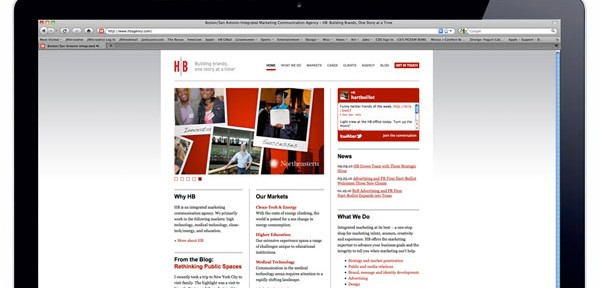
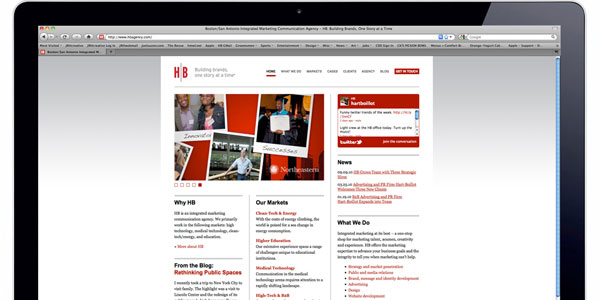
Redesign of the HB website expanded the site’s content yet used a simpler layout for organizing and sharing information. Organized and built with Contao.

» Visit Site